
Plastic Bottle Vase
I admit, this is a new project that I haven’t tried myself but it looks awesome. I went Googlin’ for a vase creation project to go with next week’s craft project – in my own defense, I remember making some vases in my youth with various materials and supplies and was trying to refresh my memory about materials.
Due to the level of skill involved with making this vase, this craft is best suited for older Juniors, Cadettes, Seniors, and even Ambassador scouts.
 Materials Needed:
- A 20 oz. plastic bottle
- Scissors
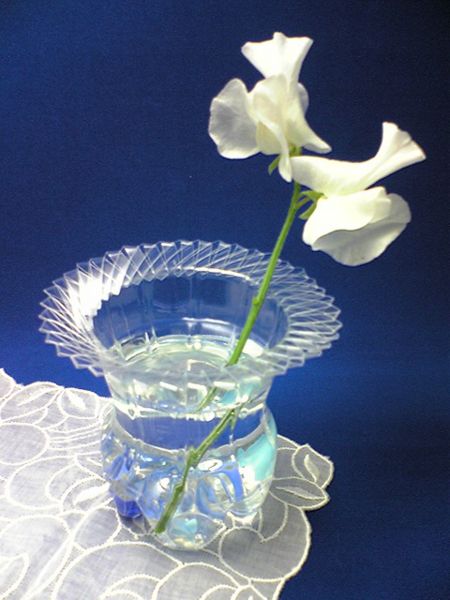
 Directions:
- Mark and cut the smooth middle portion of the bottle to give an even edge approx 7.5 to 8cm (3″) above where you want the fluted rim to be.
- Measure and make straight, evenly spaced cuts all the way around the bottle. Cut the segments in half and then cut each of those in half to make even, thin strips.
- Carefully press and fold all the strips outward to make a level edge all the way around.
- Press the bottle upside down on a flat surface to ensure an even edge.
- Weave the tip of a strip over the next one and under the next two. Fold and crease it so that the tip is at the place shown here by the arrow.
- Fold and crease the next one the same way, but weave this one over two and under one.
- Fold the third strip and weave the same as the first one.
- Continue around in this pattern until the last three and tuck each one under the next until woven in completely.
 Safety Tips!
- Use craft scissors sharp enough to cut through the lightweight plastic but not too sharp that the girls can’t handle them safely.
- Be sure to supervise carefully as the cuts on the plastic might be rough.
This looks like a beautiful project for girls that are slightly older and can do a better job with scissors. Younger girls should probably stick to easier vase projects, which will come soon!
 Quick Shopping for This Project
Boom Chicka Boom

The styles for this song can be changed or expanded on. You can easily let the girls come up with their own versions and let their creativity take over. Basically, the main part is just re-sung with the different vocal styles. This is a repeat back style song, where the song leader sings the line and the girls sing it back.
I said a boom chick-a boom
I said a boom chick-a boom
I said a boom chick-a rock-a chick-a rock-a chick-a boom
Uh-huh
Oh yeah
One more time…
Change style each time
Italiano style (boomba, rrrock-a)
Valley girl style (like, I said, like, a boom chicka boom)
Astronaut style (zoom chick-a zoom, take a rocket to the moon)
Opera Style
Janitor Style (broom sweep a broom, sweep-a mop-a)
Underwater style (using your finger to make underwater noises on your lips)
Southern Belle style (heavy Southern accent)
Broadway Musical Style (sing to the back of the room)
Etc.
Read More
Bicycle Outings & Safety Reminders
One of the best activities to get together as a troop and do is ride bikes. In any given area, whether it’s rural or urban, you should be able to do some minimal research on bike paths that are appropriate. Here are some tips for planning your bicycle riding outing.
When
Determining when to go on your bicycle riding outing greatly depends on the girls. If they’re younger girls with beginning bicycle riding skills, you will want to go riding during the day. You can schedule the ride during a meeting time if you usually meet during the day, or plan on a separate weekend outing to avoid evening rides. If the girls are older and more adept bike riders, an evening ride may be an option. Consider the maturity level of your girls and the area in which you are considering riding before making a decision whether to ride during the day or in the evening.
Where
Do some research with parents on the skill level of the girls on their bicycles. Generally speaking, if they’re younger and less skilled, you will want to research bicycle paths that are paved, exclusive for bike riders to minimize pedestrians, and as flat and straight as possible. More advanced bike riders can handle paths that are not paved, more bumpy or curved, and may have the chance of sharing the space with pedestrians. Older, more mature girls may even be able to handle more urban rides using bicycle lanes on city streets.
Once you’ve determined what kinds of skills your girls have, you can start looking for appropriate paths in your area. Even in urban areas, regional parks are usually nearby. Of course, bike transportation will have to be considered if you choose a path not close to your meeting area or neighborhood where most girls live. Regional parks are more likely to have paths or trails specifically designated for bicycles, whereas local city parks are more likely to have pedestrians sharing paths.
How
Choosing an area nearby where your meetings are normally held will increase the number of girls that can participate. This is because not every parent will have a vehicle big enough to transport a bike to a remote location or a portable bike rack for a car. Keep in mind how you are going to get the girls, their equipment, and their bicycles to the location before deciding on one.
Cost
You can decide, if doing the ride at a regional park, to charge for the outing if there is a fee to enter the park. If transportation of the bikes is an issue, you can easily rent a small moving truck or trailer for around $20 for the day. If there are girls in your troop that do not have access to their own bicycles, you can look for spare bicycles from other families willing to loan them out or consider renting them. Some areas with bicycle paths also have independent vendors that rent bicycles for nominal fees.
Preparation
Schedule the activity enough in advance for parents to make plans to get bicycles checked out and in working order, or purchase a new bicycle for their daughter and make sure she has a helmet. Planning a month in advance will give you time to make your arrangements and send out permission slips about two weeks before the scheduled date. If you decide to charge for the event, be sure to add an extra week as a courtesy for parents. Let them know what the cost is covering (i.e. park entry, transportation, parking, maybe a lunch or souvenir, etc). Be sure to make calls to the parents in addition to sending notes home if the girls are younger and prone to forgetting.
Parents also need time to register the bikes, just in case something happens. Usually the local fire station will accept bicycle registrations for a nominal fee, or you can go to National Bike Registry and do it online. $10 will cover registration for 10 years.
At least one meeting before the scheduled outing, review bike safety and proper bike riding etiquette with the girls. To make it fun you can build in a small quiz and prizes. For younger girls, tying in a craft project making their own bike licenses or safety certificates using construction paper and markers or glitter will also make it fun and keep it in the forefront of their minds.
 Safety
Remember the girls’ safety is YOUR responsibility. Be sure to brush up on these safety tips and review bicycle safety the meeting before your outing so the girls are best prepared.
- Stop at all stop signs and obey traffic lights just as cars do. Yield to pedestrians, stop at red lights, and be especially careful at intersections.
- Always ride in the same direction as cars do. Never ride against traffic.
- Always wear a helmet, even adults. Some states don’t require adults over age 18 to wear a helmet, however you should wear as a good example.
- A safety check should always be done on the bicycles before riding. All bicycles should have their brakes in proper working order with reflectors on the front, rear, and on the wheels.
- If you’re planning on riding in the evening or at night, bicycles should be equipped with a light on the front and rear of the bicycle. Girls should also wear a reflective vest or light colored clothing.
- Remember your bicycle hand signals:
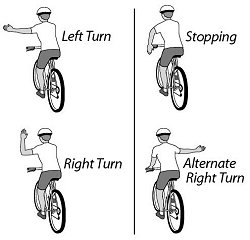
Bike Hand Signals
- When riding on a path also being used by pedestrians, be aware of how close you are getting to groups and identify yourself as a bike rider.
- When passing other bikers or people on the street, always pass to their left and call out “On your left!” so they’ll watch for you.
- Never share the seat with a friend or ride on the handlebars — only one person should be on a bike at a time. It’s easy to lose balance or suddenly swerve into traffic when riding with a passenger.
- When encountering a large group of pedestrians, it’s best to pull to the side and get off of the bicycle and walk past.
- If riding on the sidewalk, get off and walk your bicycle across the street, staying in the cross walk.
- At least one person traveling with your group should know how to fix a flat tire and carry a flat tire fix kit and portable tire pump.
- At least one adult should lead the group and another should bring up the rear, with other available adults dispersed through the group.
- Girls should always wear pants or shorts when riding. Pants should be fairly tight at the ankle or able to be folded up or secured above the knee on the side of the gears if there is no gear guard. Special bands can be purchase from bicycle or sporting goods shops to secure pant legs from getting caught in the gears. In a pinch, masking tape can be used.


